Thursday, March 02, 2006

Whats going on with the nuke deal?

I dont know. Political soundbytes have made me believe that the success of Bush's India visit depends on the nuke deal between the two nations, and when it involves nukes, I know it can be a very touchy subject.

I am not able to understand why the two countries are in such an overdrive to hammer out a deal while President Bush is still in India, because from what I see, there are a lot of sticky issues still. There are a lot of things US wants India to do, and there are a couple of things that India doesn't want the US to insist it does.

The Fast Breeder Reactor project is aimed to be a premier Indian R&D masterpiece which will guide our future civilian nuclear energy. Our scientists don't want it under the civilian sector, thus bringing it under the purview of the IAEA. I put together a couple of media reports to see whats going on.

Factbox: Indo-US nuke negotiations

Here is a snapshot of nuclear power in India and the issues under discussion between New Delhi and Washington:

- India has 15 nuclear power plants in operation, with an installed generating capacity of 3,310 megawatts (MW). Seven more plants with a capacity of 3,420 MW are under construction and scheduled for completion by 2009.

In addition, there are two research reactors, which produce most of the country's weapons-grade uranium. Nuclear power accounts for about 2.7 percent of India's generating capacity.

- Under a July 2005 deal, agreed in principle between India and the United States, New Delhi would commit itself to certain non-proliferation standards including allowing international inspections of its civilian nuclear plants.

In return, it would gain access to U.S. civilian nuclear technology, including fuel and reactors denied for 30 years. India's military facilities would not be subject to inspections under the deal.

- The agreement hinges on India separating its nuclear facilities into civilian and military components.

- The United States has said it expects the "great majority" of India's nuclear reactors to be placed in the civilian list. But top Indian nuclear scientists are opposing this, saying it would place restrictions on the weapons programme.

- Only four nuclear power plants in operation (capacity 620 MW) and two under construction (capacity 2000 MW) are currently under International Atomic Energy Agency (IAEA) safeguards.

- Indian Prime Minister Singh said this week that New Delhi would place nuclear reactors that generate about 65 percent of atomic power in the civilian list and open to inspections.

- Indian scientists are especially opposed to classifying the experimental "fast-breeder reactor" (FBR) programme in the civilian list, saying it is part of the country's research efforts. The FBRs, which use spent fuel from existing heavy water reactors to process plutonium, are intended as the mainstay of the country's nuclear power programme.

- Non-proliferation experts in the United States have said that the deal would allow the rapid expansion of India's nuclear arsenal and encourage Pakistan and China to respond.
________________________________________________________

Okay, so the FBR's are a major point of argument here, and the PM has assured the Parliament that they will not be classified under the civilian sector.

Deal ya no deal

United States President George W Bush on Wednesday landed in New Delhi for a visit whose success is being inextricably linked to the India-US nuclear deal.

However, aware of the complexities and the pitfalls involved in the deal, US Secretary of State Condoleezza Rice cautioned the media that Mr Bush's trip is "not a civil nuclear power trip". Although Ms Rice, as also the Indian side, are now trying to dilute the overwhelming focus on the deal, in case nothing substantial is signed and the visit is termed a "failure", it is the deal that has kept Indian and American officials on their toes in the run up to the visit.

En route India, when asked about India's refusal to place its Fast Breeder Reactors (FBRs) in the civilian list, Ms Rice asserted, "The key here is that India has to demonstrate that it is prepared to put its civilian reactors under safeguards, and do so permanently." Once placed under international inspection, India would not be able to convert them into military reactors.

Prime Minister Manmohan Singh on Monday assured Parliament that FBRs would be kept away from international surveillance, an issue that has become a major sticking point in the deal.

Ms Rice, however, clarified, "There are a variety of ways that might happen. I don't want to get too much into the discussions that we're having on particular types of reactors, but I think not every reactor and not every type is going to be under safeguard."

Such a deal involves India's offer of placing 14 reactors on the civilian list for the present while giving an assurance of placing the remaining eight after about a decade. Critics of the deal here feel FBRs are indigenously produced and must therefore never be subject to international inspections. Also, it is felt that the "reciprocity" clause in the July 18 agreement has not been adequately met by the Americans, with the US Congress still far from amenable to the deal.

In India, the main opposition is based on the premise that nuclear energy, even at its peak capacity, would only address 6-8 per cent of India's total energy requirements which contests the justification of India laying bare its nuclear energy plans to international inspectors. Also, the scientist community feels Indian reactors cannot be subject to permanent safeguards as India is not a signatory to the Nuclear Non-Proliferation Treaty.

Clearly, the historic nuclear deal was meant to be the centrepiece of Mr Bush's India visit when the two countries signed the agreement on July 18 last year. But it has run into such rough weather that the two sides were left "working" on the deal hours before Mr Bush landed in New Delhi.
______________________________________________________

You wanna know what I feel? Ehh, not gonna happen, at least not yet. But lets wait and see. Theres two days to the visit still.

To love him or love him not?

Theres a Philadelphian hiphop group called Immortal Technique, and in one of their songs, they say, "I love the place I live in but I hate the people in charge."

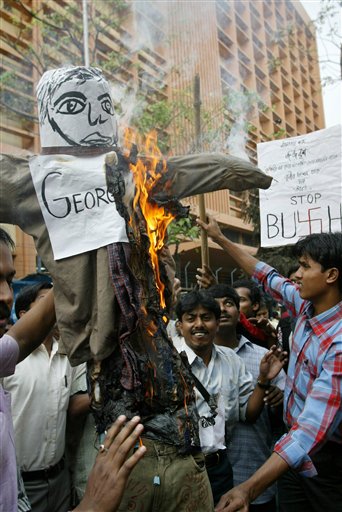
I find this quote to be very appropriate for the theme of my post, that of increasing Indian admiration for all things American, but an apparent distaste for its President. Led by all and sundry, there are protests all over the country over the arrival of President Bush. His effigies have been burnt, black flags have been waved in streets and are fluttering atop the highest mosques. They want India to have nothing to do with the 'killer' Bush. however, if a global survey conducted last year is to be believed, all this protest is hogwash, because it seems we love President Bush as well!

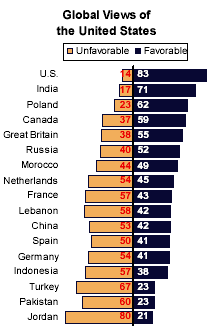
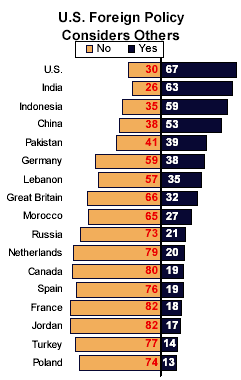
I think late last year, The Pew Research Center in Washington DC, USA, conducted the 2005 Global Attitudes Survey, and remarkably, Indians love the United States, and surprisingly, love President Bush as well. They agree with the the US foreign policy, and that the US takes everyone's concerns in regards before taking actions. (ah my starry eyed breathren!) Of course, it remains the land of opportunity and inventiveness.

I think I can understand the demographics that were surveyed by the Center. Many of India's well to do families, including the top brass in the Government, have immediate family settled in the US, including the Prime Minister, and other top ministers. So many of the respondents probably belongs to the richer class of society, with somebody from their family in the United States. The lower middle and working class doesnt have as many sons, daughters or in-laws in the US, and maybe they were a minority respondents for the survey, if surveyed at all.

Lets see what Pew has to say....

India: Pro-America, Pro-Bush

Looking for some good news amid the often dismal findings about America's image abroad? Try India. Anti-Americanism has surged in much of the world since the beginning of the Iraq war in March 2003, but India has bucked the trend. Among Indians, America's image has actually improved in recent years.

The 2005 Pew Global Attitudes survey found that about seven-in-ten Indians (71%) have a favorable view of the United States. Of the 17 countries polled in the survey, only Americans themselves hold a more favorable view of their country. And while U.S. favorability ratings have plunged in many countries, Indians are significantly more positive about the United States now than they were in the summer of 2002, when 54% gave the U.S. favorable marks.

In the world's largest democracy, moreover, President Bush, who is unpopular in many countries around the globe, is also widely admired. Just over half (54%) of Indians say they have a lot or some confidence that Bush will generally do the right thing in world affairs, a significantly higher percentage than in any other country except his own.

Indians also have a strongly positive impression of the American people - 71% have a favorable opinion of Americans, up from 58% in 2002. Moreover, Indians tend to associate Americans with positive character traits, and generally do not associate Americans with negative characteristics. Eight-in-ten (81%) Indians consider Americans hardworking, and 86% - the highest percentage of any country surveyed, including the U.S. itself - say Americans are inventive. Fewer (58%) regard Americans as honest, but even among U.S. respondents, Americans receive mediocre marks for truthfulness (63%).

And America remains a land of opportunity for many Indians. Asked where they would recommend that a young person move in order to lead a good life, a 38% plurality of Indians choose the United States.

In many countries, anti-Americanism is driven by disagreement with U.S. foreign policy. Indians, however, largely approve of the way the U.S. conducts itself in the international arena. For example, Indians are less likely than others to believe the U.S. acts unilaterally on the world stage - 63% of Indians say the U.S. takes into account the interests of other countries when making foreign policy decisions.

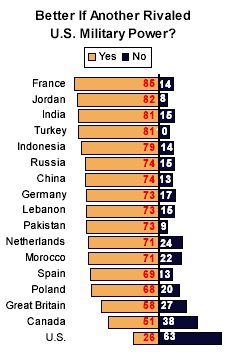
Despite their pro-American attitudes, Indians would like to see another power become as militarily strong as the United States. Indeed, Indians are among the most likely to favor another country or group of countries rising to the level of global superpower. Still, there is less support among Indians for China becoming as militarily powerful as the United States. Indians are split over this issue, with 45% saying that if China became America's military equal this would be a good thing and 45% saying this would be a bad development.


____________________________________________________________

While at the same time, we have.....

Protest rallies to welcome Prez

There have been widespread protests across the country against the much-hyped Bush visit.

From Bhopal, where the 1984 gas leak victims have taken to streets and are shouting slogans, to Hyderabad where anti-Bush campaigners have found a unique way of expressing themselves, the protests have been widespread..

In New Delhi, thousands took out a massive protest rally, waved black and white flags and chanted slogans like "Death to Bush!", "Bush, Bush, go home" and "Death to America, death to Bush".

According to the Delhi Police, nearly one lakh people, mostly Muslims gathered in Delhi's Ramlila ground for the protest march.

The Left parties are also planning to protest in front of Parliament on Thursday.

On Tuesday, nearly 1,000 people demonstrated in Mumbai, waving placards reading "Devil Bush Go Back," with caricatures of Bush as a cross between Superman and Satan.

Some mosques in Hyderabad have already unfurled banners protesting his arrival. Bush would visit the city for four hours on Friday.

Members of the Students Federation of India (SFI) and the Communist Party of India (CPI) burned effigies of Bush in the city.

Surprise checks and raids were being carried out at several sensitive parts of the national capital and activities of travellers to the city were being monitored closely.

Police were also keeping a watch on budget hotels in busy areas like Paharganj and Karol Bagh to look out for any suspects.

CRPF, Rapid Action force and Delhi Police personnel will be deployed along the Ramlila Grounds-Parliament Street road, the route of a rally against Bush's visit organised by the Left Parties.
_______________________________________________

Lets see what Voice of America has to say. Wow, we had that many protesters? Sweet!

Tens of Thousands of Indian Muslims and Communists Protest Bush Visit

Tens of thousands of Muslim and communist protesters have rallied in India's two


major cities to protest President Bush's trip to India.

Muslims wearing prayer caps filled a fairground in New Delhi, waving black flags and shouting anti-Bush and anti-Iraq war slogans.

In Calcutta, also known as Kolkata, thousands of communist supporters converged downtown to take part in a public meeting arranged by the "Committee Against Bush Visit" to protest against American policies around the world.

Wednesday, March 01, 2006

George Bush arrives in India


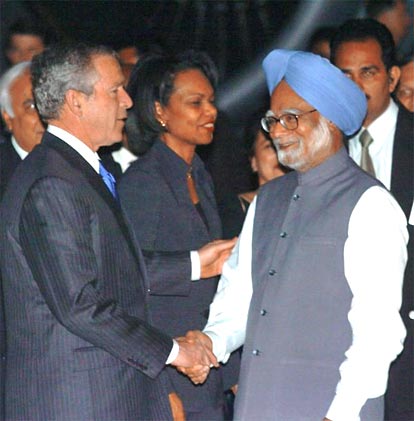
US President George Bush has a lot on his plate in his first ever visit to India. The President arrived in New Delhi on March 1st, greeted by the Prime Minister, who broke protocol to be there to greet Bush and his wife. Secretary of State, Condoleeza Rice, is with the President on this visit.

Of course, the nuclear deal is the number one issue on everyone's mind, and there are speculations galore of India and the US working out a deal before or when the President lands here. I was listening to the Prime Minister's interview on American host Charlie Rose and he said people were hard at work hammering out the details of such a deal and he said such a deal would go a long way in guiding the Indo-US relationship to a better tomorrow.

The PM downplayed persistent questions from the host regarding the US attempt to stand India as a bulwark against a rising China. He said China and India are not to be looked as rivals but as accessories to each other. We are both on the same trajectory of growth and development, and he actually said he agreed with China's ambition to be a global power, but within the framework of a pluralistic world order. India had similar ambitions, and thus he totally understood where China's coming from.

Lots of diplomatic speak, I know, but the Prime Minister made it clear that India will not be a puppet state of the US (not in those terms of course).

By the way, according to the 2005 Pew Global Attitudes Project, a worldwide survey conducted by the Pew Research Foundation, Indians have a very favorable view of the United states, more than Canada or United Kingdom! Oh man, this calls for a whole new post. Of course, prior to his visit to India, there were a lot of feel-good articles in the American Press, calling the next big thing and all that, and also how President Bush was such a big fan of India. May some of it is sincere and true, but more sincerely, I hope our establishment is not as prone to flattery as you and me.

Lets see what the President and the First Lady have on their three day agenda in India:

Bush Visit: Heavy agenda awaits George Bush

Bush, the second US President to visit India in six years, will arrive here on Wednesday evening in the first leg of South Asia trip that will take him to Pakistan also.

In a special gesture, Prime Minister Manmohan Singh is expected to receive him at the Palam technical airport.

Bush will be accorded a ceremonial reception at the Rashtrapati Bhavan on the morning of March two, where President A P J Abdul Kalam and the Prime Minister will be present.

Following this, the US President will visit Rajghat to pay his tributes to Mahatma Gandhi.

Singh and Bush will subsequently hold extensive talks at Hyderabad House. Among the issues to be covered is the July 18 nuclear deal, besides cooperation in various other fields like science and technology, space, energy, education and health.

The two leaders will then jointly address the press. A meeting of CEOs' Forum will also take place.

UPA chairperson Sonia Gandhi and leader of Opposition L K Advani will call on the visiting dignitary, after which Kalam will host a banquet in his honour on the same day.

On March three, Bush will visit Hyderabad and return in the evening to address a select group of people from the field of politics and business at Purana Quila, in the backdrop of the scenic beauty.

Us First Lady Laura Bush will also have a hectic schedule. She will visit a charity home and a destitute home in Delhi besides a hospital in Noida.


__________________________________________________________________

Bush arrives, PM breaks protocol to receive him

Bush's Air Force One landed in Delhi at 1935 hours (IST) and the US President and the First Lady stepped out of the aircraft.

Before driving to Maurya Sheraton Hotel in his armour-plated limousine specially flown from US, he shook hands with Science Minister Kapil Sibal, the minister in waiting, National Security Adviser M K Narayanan and Foreign Secretary Shyam Saran and US Ambassador David C Mulford.

Bush has no official engagement on Wednesday night and will be ceremonially welcomed at the Rashtrapati Bhawan when he has a heavy schedule.

Earlier at a surprise stopover at Kabul, Bush said US negotiators were trying to iron out differences with their Indian interlocutors from aboard Air Force One to wrap up an agreement for the implementation of the landmark nuclear deal.

He said: "it is in the interest of the US and in the interest of the countries around the world that India develops a nuclear power industry."

President Bush will be accorded a ceremonial welcome at Rashtrapati Bhavan at 9 am on Thursday.

During this tour, Bush is expected to cement American alliances with India and also likely to hammer out a landmark agreement to share civilian nuclear technology with New Delhi.

By Wednesday evening, there were enough indications that the nuclear deal is almost in the final stage. Sources have revealed that a declaration is being readied for Prime Minister Manmohan Singh and President George W Bush.

Rejecting the notion that if the nuclear energy initiative is not signed during the present visit then the deal could lose its momentum, Rice told reporters on Air Force One that sticking points remained in the way of the nuclear agreement.

The provision Rice cited would prevent India from transferring a reactor from civilian to military status, thus exempting it from international inspections.

The President's National Security Advisor Stephen Hadley, also part of the Presidential delegation, brushed aside criticism that the civilian nuclear arrangement with India has been so designed so as to go around the non-proliferation treaty and frameworks as some critics have argued.

Bush is also scheduled to hold a series of meetings with UPA Chairperson Sonia Gandhi, Leader of the Opposition LK Advani and former Prime Minister Atal Bihari Vajpayee at Maurya Sheraton in the afternoon.

Later in the evening, Bush will call on President APJ Abdul Kalam, to be followed by a state banquet.

Union Budget 2006-07

Hello, here some of the high lights of the Union budget presented in the Lok Sabha by the Finance Minister, Shri. P Chidambaram on February 28th.

Highlights of the Union Budget 2006-07

  • GDP growth for FY06 likely to be 8.1% with the manufacturing sector at 9.4% ; agricultural growth bounced back to 2.3%; inflation, as on February 11, 2006 was 4.02%; non-food credit growing by over 25%.
  • BHARAT NIRMAN: In the first year of implementation, 2005-06: Rs 944.18 crore released so far as grant under AIBP, target of 600,000 hectares of irrigation potential expected to be created this year; against target of 56,270 habitations, 47,546 habitations covered until January, 2006.
  • Sarva Siksha Abhiyan: 93% of children in age group 6-14 years are in school, number of children not in school has come down to about one crore; outlay to increase from Rs 7,156 crore to Rs 10,041 crore in 2006-07; 500,000 additional class rooms to be constructed and 150,000 more teachers to be appointed; Rs 8,746 crore to be transferred to the Prarambhik Siksha Kosh from revenues through education cess.
  • ational Rural Employment Guarantee Scheme: allocation of Rs 14,300 crore for rural employment in 2006-07 with Rs 11,300 crore under NREG Act and Rs 3000 crore under SGRY, more funds to be provided according to need.
  • Tourism: development of 15 tourist destinations and circuits to be taken up; 50 villages with core competency in handicrafts, handlooms and culture, close to existing destinations and circuits, to be identified and developed; 4 new institutes of hotel management to be established in Chhattisgarh, Haryana, Jharkhand and Uttaranchal; Plan allocation increased from Rs.786 crore to Rs.830 crore.
  • Telecommunication: to reach 250 million connections by December, 2007, provision of Rs 1,500 crore for Universal Services Obligation Fund in 2006-07; more than 50 million rural connections to be rolled out in three years.
  • Power: five ultra mega power projects of 4,000 MW each to be awarded before December 31, 2006; to create an enabling and empowered framework to carry out reforms an Empowered Committee of Chief Ministers and Power Ministers to be setup
  • Petroleum: under NELP VI., 55 blocks and area of 355,000 sq kms offered; investment of Rs.22,000 crore expected in the refinery sector, in the next few years.
Media Reaction:

No big ticket reforms, PC plays it to the gallery

The Union Budget for 2006-07 proposes no changes in personal and corporate Income Taxes, slashed customs and excise duties on a number of items - including small cars and aerated soft drinks - and brought 16 more items like ATM operations and luxury class air travel under the service tax net.

Presenting his third Budget in Lok Sabha on Tuesday, Finance Minister P Chidambaram also abolished the one-by-six scheme for mandatory filing of tax returns and proposed across the
board increase in the Securities Transaction Tax while announcing a roadmap for a Goods and Service Tax in four years.

He did not bow to the demand of the industry to withdraw the controversial Fringe Benefit Tax but modified it to remove some of the glitches in its implementation. Similarly, he ruled out withdrawal of Banking Cash Transaction Tax.

Pegging the Fiscal Deficit for 2006-07 at 3.8 per cent of GDP at Rs 1,48,686 crore and Revenue Deficit at 2.1 per cent at Rs 84,727 crore, Chidambaram raised gross budgetary support for plan to Rs 1,72,728 crore, an increase of 20.4 per cent. Out of this, the central plan will receive a support of Rs 1,31,285 crore.

Defence allocation has been increased by Rs 6,000 crore to Rs 89,000 crore with allocation for capital expenditure raised to Rs 37,000 crore.

To encourage savings, the Finance Minister announced that fixed deposits in banks with at least five year maturity will get rebate under income tax for savings under Section 80C.

Chidambaram made changes in FBT relating to valuation of benefit on tour and travel at five per cent instead of 20 per cent. On hospitality and hotel boarding and lodging in case of airlines and shipping industry too, the benefit is to valued at five per cent.
___________________________________________________

PC paints magical picture, pleases all

Finance Minister Palaniappan Chidambaram told Parliament Asia's third-largest economy was likely to grow 8.1 per cent in the financial year ending on March 31 but the government was determined to raise that to 10 per cent in the next few years.

"The assault on poverty and unemployment continues. I believe that growth is the best antidote to poverty," he said.

Chidambaram said the budget for the year ending in March 2007 set the allocation for spending on a rural jobs guarantee scheme at 143 billion rupees ($3.2 billion) from 117 billion in 2005/06.

He also planned to increase expenditure on education by 31.5 percent, health by 22 percent and boost spending on rural infrastructure projects to 186.96 billion rupees in the coming year.

INFRASTRUCTURE:

* Government aims to raise power generation capacity by 15,000 megawatts by March 2007

* Comprehensive review of coal policy needed

* Government expects investment of 220 billion rupees in oil refining over next few years. The government will encourage investment in refineries, pipelines and green fuel.

* Highways development programme to receive 99.45 billion rupees in 2006/07. The government has identified three new road projects to be built under a new special purpose vehicle.

Monday, February 27, 2006

Could there still be hope for Jessica?

After the Jessica Lall verdict was out last week, I for one, was outraged, and fortunately, so was the rest of the nation. I think the media took this incident up in a big way. I think we are used to hearing of the big and powerful getting justice on their side, but more often than not, these stories come from far and wide, maybe mainly from the hinterlands.

Jessica Lall case was different. It involved the rich socialites of New Delhi, the sons and newphews of the rich and powerful, stuff that media coverages are made of. I too had been reading about the stink the verdict raised in all media sections; I think NDTV started an online petition campaign against the verdict, and they say they have over a lakh signatures already. Every paper was full of opinion pieces on the sad state of judicial reforms, or the society in general.

I was planning to keep writing follow-ups to the verdict, maybe news opinions mostly, but as I checked the morning news, the first thing I do every morning, the headline read that the centre hints at reopening the case! This is big news, because when the centre is planning to get involved, there is usually a hope that it is for the better. Also, the Delhi High Court had asked for details of the investigation from the Delhi Police chief already. His force has begun damage control already by the way.

When they will talk about bad timings, I think this case should be right up there. Soon after the verdict, the judge who was presiding over the case was elevated to the Delhi High Court from the Additional Sessions Court. Now activists and bar associations of all kinds are up against Judge KL Bhayana for shaking their faith in the system. To be fair, when a judge is presented with a very poor and half-hearted investigation, an even weaker prosecution, what is one supposed to do? But then he also knew that this was the classic case of the guilty being rich and powerful. He did say the prosecution presented a very weak case, but maybe he could have referred to some higher courts.

Last week, Manu Sharma and his family make a pilgrimage to Mata Vaishno Devi in J&K to be obeisance to the Goddess, and good for him, for to be fair, I think the Gods usually do not differ between sinner and sinned till their day of judgement. Lets hope that day comes soon for this spoilt asshole and his posse.

Coming to the government, I am no fan of part of the cabinet of MMS, and the home minister is one of them. He said on the floor that the says one can't be tried again in "any case". Hmm, perhaps I am missing a point, but what was the Best Bakery retrial about? Werent the same acquitted men ordered by the Supreme Court of India to be retried? I know the GoI usually lacks what we call balls, and I think they are only doing this because of the public outrage. And as you know, where there's trouble, there'll be a politician to exploit it.

This is from the The Tabloid:

Centre hints at reopening the Jessica Lal murder case


The government has indicated there could be a reinvestigation into the controversial case relating to the murder of Delhi model Jessica Lal but ruled out a retrial.

"As the law exists today, no person should be tried twice in any case," Home Minister Shivraj Patil said in a statement in the Rajya Sabha after MPs cutting across party lines demanded in both houses of Parliament that the controversial case be reopened.

"The Supreme Court has ordered reinvestigation in some cases and it has become a kind of law also for us. It can be followed," Patil said. He assured the members that "whatever is possible as per law to see that justice should be done will be done. Let there be no doubt."

The home minister said the government was keen to incorporate provisions to protect witnesses in such cases to prevent them from turning hostile under pressure.

____________________________________________

Investigator in Jessica case transferred

Surendra Sharma, the investigating officer in the controversial Jessica Lall murder case, has been transferred from the post of Station House Officer of Hauz Khas police station to security wing of Delhi Police which doesnot involve any probe assignment.

Paul, who was the Joint Commissioner (Crime) when the murder case was being investigated in a report to the then Commissioner Ajai Raj Sharma, had questioned the intention behind sending empty rounds of bullets fired at the Tamarind Court party for forensic examination to the CFSL when the weapon of offence had not been recovered.

He had also suggested an internal probe against officials investigating the case.


_____________________________________________


Police asked to explain shoddy probe into Jessica's murder

Delhi High Court on Friday sought an explanation from Delhi Police on the shoddy manner in which it had investigated the 1999 murder of model Jessica Lal, leading to all nine accused in the case being acquitted.

Judges Vijender Jain and Rekha Sharma asked the police to respond by April 19.

According to the prosecution, Manu Sharma shot dead Lal on April 29, 1999 after she refused to serve him a drink in a bar functioning without a licence. Lal was filling in as a bartender at the Tamarind Court bar, near the Qutb Minar, run by socialite Bina Ramani. It was later shut down.

Of the 12 accused in the case, one was discharged and two are absconding.

The nine accused who were acquitted are Manu Sharma, his uncle Shyam Sunder Sharma, Amardeep Singh Gill, Yograj Singh, Harvinder Chopra, Vikas Gill, Raja Chopra, Alok Khanna and Vikas Yadav, the son of former Uttar Pradesh MP DP Yadav.

Vikas Yadav is also accused of murdering a business executive, Nitish Katara, because he objected to his involvement with his sister Bharati.

Vikas Yadav, Alok Khanna and Amardeep Singh Gill were charged with destroying evidence and conspiracy.

Shyam Sunder Sharma was charged with harbouring an offender and destroying evidence, and Yograj Singh, Amardeep Singh Gill, Harvinder Chopra and Raja Chopra were also charged with harbouring an offender.

The accused were acquitted on four grounds. First, the prosecution failed to recover the weapon that was used to kill Lal.

The court said the prosecution also failed to prove that the two cartridges recovered from the spot were fired from one weapon. A forensic report had said the two cartridges were fired from two different weapons.

Third, the three eyewitnesses in the case, including model Shayan Munshi, refused to support the prosecution's line and turned hostile.

Fourth, the prosecution failed to present a complete chain of circumstances of the case, the court said.